Study 3: Color Key
2023年8月15日
Associated Lesson: 🌈 Lesson 3: Color (The Greatest Lie)

Zac Retz, Rainy LA
The goal of this study is to produce a color key: an atmospheric color map of a drawing.
Warning: This week’s study is quite difficult. On your first attempt, start with something slightly simpler than what you would normally be comfortable with. To help you out, we suggest using niji scenic, which consistently shades in warm light and cold shadow, to help you practice that transition.
Start with an image from niji --style scenic.
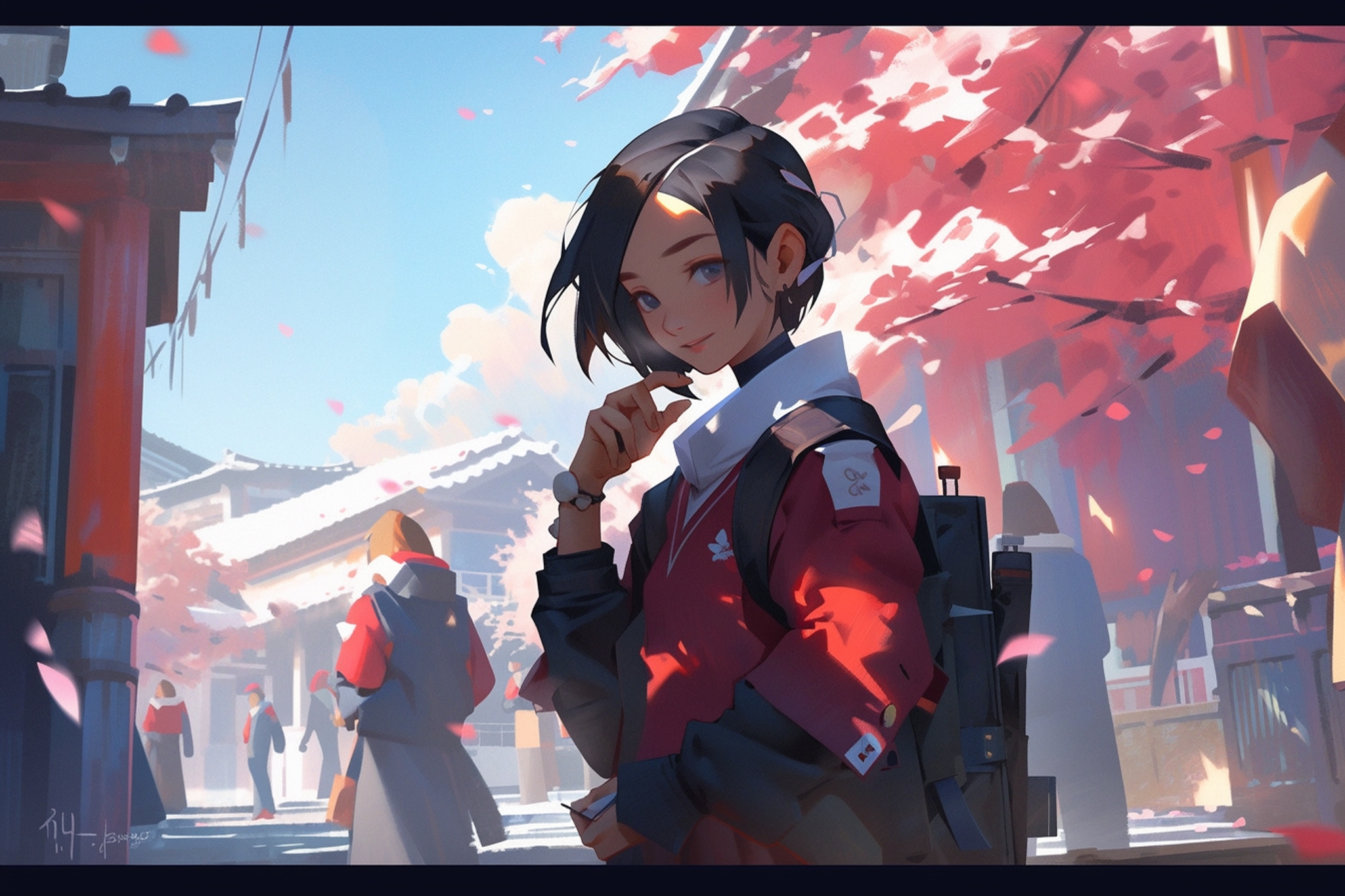
Step 1: Trace out the rough areas of the drawing. (Yes. Definitely trace it!)

Step 2: On a new layer, using the paint bucket, lay down the rough colors that you see (don’t use the color picker!)

Step 3: Check your estimation by zooming out super far and squinting at it: is the thumbnail about the same picture?

Step 4: Turn off the lines from before and Draw in some secondary shapes

Step 5: Estimate the color of the secondary shapes
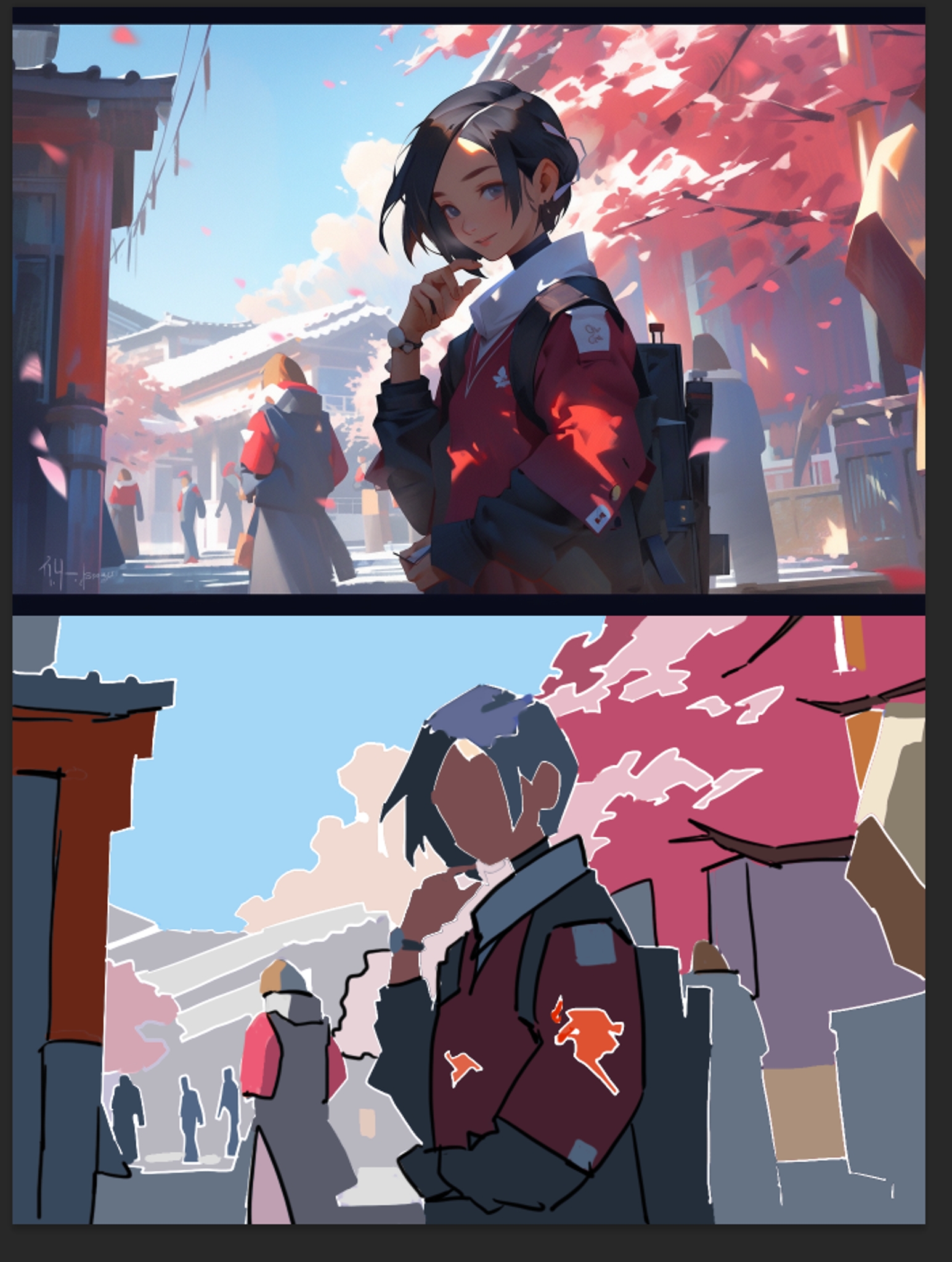
Step 6: Squint again (slightly larger this time) and adjust

Step 7: Carefully fill in the white lines with the boundary color you observe.

Step 8: keep on squinting and checking!

Step 9: Touch up with details
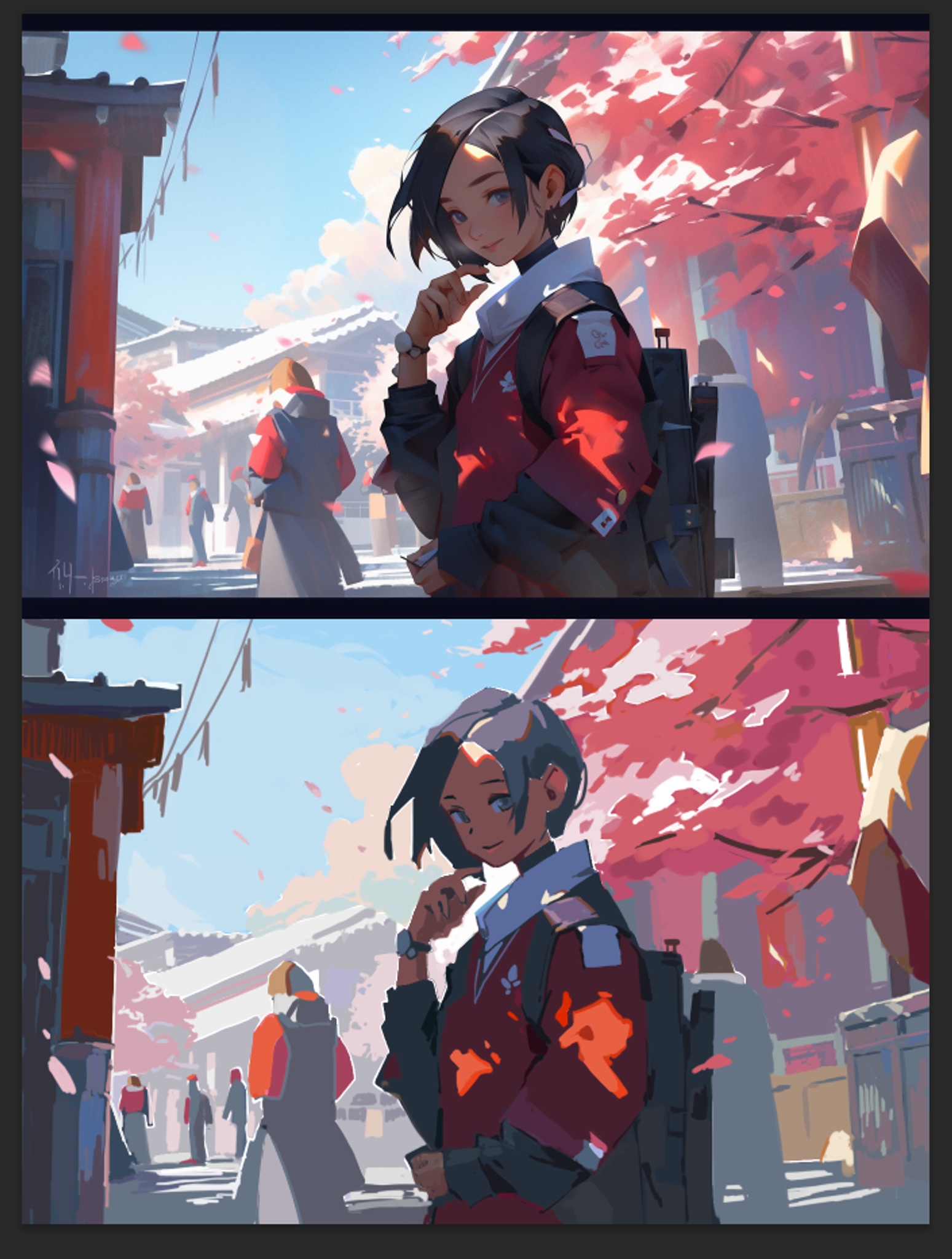
Step 10: Done!
Show it to blk cat with the /submit command at https://discord.com/channels/1017943945214435438/1129477874823479387

When making a color warmer or cooler, use RGB color space:

More R and less B corresponds to warmer. More B and less R corresponds to cooler.
When changing the value and saturation of a color , use HSB color space:

S will increase/decrease saturation. B will increase/decrease brightness.

When approaching a transition, figure out whether the transition is in saturation or brightness. Oftentimes, transitions in brightness are cushioned by transitions in saturation.
Don’t use digital blending to make transitions. Instead, use your eyes to measure carefully. Even soft gradients like this can be modeled by a hard brush with the correct color loaded. Remember, we must organize and simplify.


When adding details, always preserve the hierarchy of their relative strength in the reference. Remember, we must always draw a clear terminator line. Here, region 1 is the terminator line, and region 2 is behind the terminator line, so the transition 2 must be less dramatic than than transition 1!
Yes! You can do it!
Don’t skip the squinting steps! Go carefully and slowly: with how many dimensions there is to color, this exercise can easily get out of hand if the previous steps are not done correctly. Aim to draw as little as possible, instead, spend time picking your colors with great care.
With studies 1, 2, and 3, you have learned the 3 types of “measurement”!
Niji Academy lectures will now take a break for 1 month, to give you time to hone your measuring skills.
When we come back, we will teach you how to turn what you have measured into something of your very own.
Keep drawing! You can do it!
Please note, the in-class demo incorporates a soft brush, which is a more advanced version of the technique above.
Using a soft brush will help you beautify edges, but remember, in this exercise, you should never use the brush to make a transition. (otherwise known as “turning the form”)
In other words, imagine the brush you are using as a color on top of the same plane, but DO NOT turn the angle of the plane using the brush.
This is a technique that combines edges of 100% hardness with edges of 0% hardness, where the method above uses only edges of 100% hardness. Give it a try!

100 drawings is a marathon, not a sprint. Approaching the challenge with the correct mindset is the key to finishing it. Here are my recommendations for how to scale the challenge to your level.
If you have made less than 100 finished drawings in your life:
You aren’t necessarily looking for the fastest way to improve, but you want to try it out.
Focus on cultivating the habit. Rather than worrying about accuracy, try to find the subject matter that will motivate you to draw every day.
The only way to lose as a beginner is to stop drawing.
If you have made between 100 and 500 finished drawings in your life:
You’ve tried this for a while, and you want to know the fastest way to get better.
Focus on maintaining discipline: Don’t make lazy drawings. (Meaning, don’t make drawings where you can turn your brain off)
Identify your own weaknesses: if you follow reference too closely, challenge yourself to interpret the reference more loosely. If you have problems with accuracy, try harder to maintain the reference
Always draw with a reference. (Period. Full stop. No exceptions.)
You’re not necessarily looking for an intense workout: You want to draw for fun.
That is welcome too! Do not be intimidated: It’s ok to follow the beginner prescription!
If you have made more than 500 finished drawings in your life):
You know how this works, you’re here for community
Focus on trying out some new things: There’s no social media points or job-related expectations here. Take advantage of that! blk cat loves all drawings!
Encourage your peers! Sometimes all it takes is a bit of community to hit that next personal record.
相关文章
niji・journey
niji・journey 是什么?
欢迎来到 niji・journey。这是一款最先进的 AI 生成器,可以绘制任何二次元风格的图像!本魔法般的工具是由 Spellbrush 与 Midjourney 所共同设计开发的。无论您是在寻找可爱的 Q 版角色还是充满动感的动漫场景,niji・journey 都能将您的想象变为现实。我们迫不及待地想看看您创造了什么!


我们可以在哪里找到您?
如果您是一名 AI 研究人员并且喜欢二次元,欢迎将履历寄至 [email protected]。
如果您是位才华横溢的求知者,可以前往我们的招聘页面上查看其他空缺职位。
如需商业咨询和工作室授权等,请联系 [email protected]。